
A custom fragrance has five cost layers — development, raw materials, packaging, compliance and tooling — and the brief decides how far each one runs. Most price surprises are not the factory's fault; they are decisions the brief left open. Cost the project as a stack rather than a unit price, and you will be able to compare supplier quotes honestly.
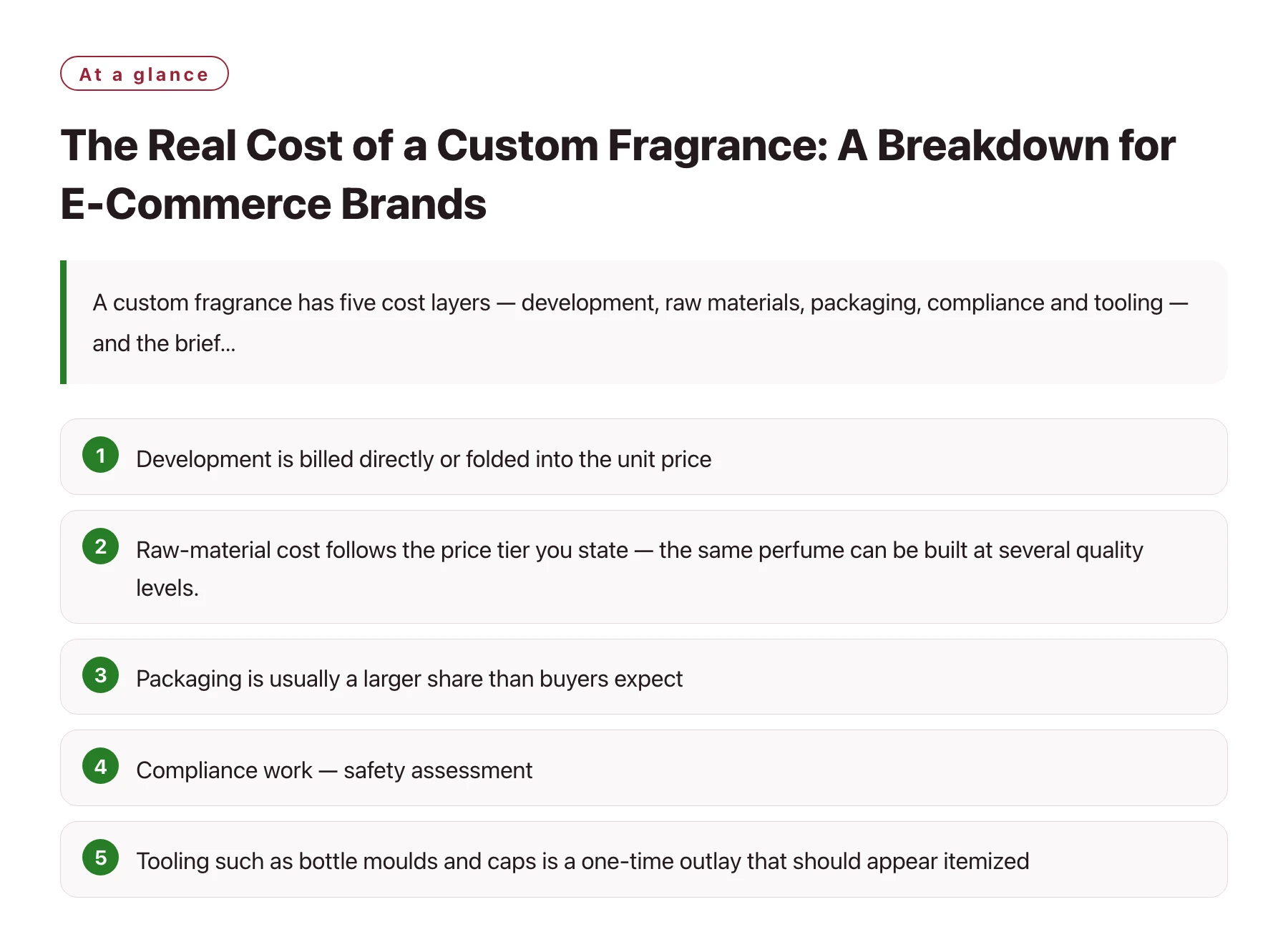
Key takeawaysDevelopment is billed directly or folded into the unit price; a brief that reuses known accords lowers it, a brief that demands originality raises it. · Raw-material cost follows the price tier you state — the same perfume can be built at several quality levels. · Packaging is usually a larger share than buyers expect, and its decoration choices move both cost and lead time. · Compliance work — safety assessment, ingredient documentation, stability testing — is recurring, and it restarts whenever the formula changes. · Tooling such as bottle moulds and caps is a one-time outlay that should appear itemized, because it amortises differently at different volumes.
"How much does a custom perfume cost?" is the first question every e-commerce founder asks, and it is the one question no one can answer without a brief. The honest answer has five parts, and the ratio between them changes with every decision you make.
This article breaks the project into its cost layers, shows which decisions in your brief move which line, and gives a quick method for reading a supplier quote without being blindsided.
The five layers of the quote
Development is the layer most buyers misread. A fragrance does not arrive from a catalogue; someone has to interpret your brief, select materials, blend trials and iterate to an approval. That work is either billed as a development fee or folded into a higher unit price. The brief controls it directly: a concept that can be built on a known base costs less than one that demands an entirely new accord.
Raw materials come second, and they are the layer where tier really shows. The same olfactory impression can be built with different quality materials at very different costs, and the perfumer chooses based on the tier you state and the constraints you list.
Packaging is the layer e-commerce buyers underestimate most. A striking bottle, a decorated cap, a printed carton and their minimum order quantities can outweigh the concentrate in the final landed cost. The packaging specification in your brief is a cost decision, not a design decision.
Compliance is the layer that never ends. Ingredient documentation, safety assessment and stability testing are paid for repeatedly, and they restart whenever the formula, the label or the pack changes. For EU-bound products, the ingredient database and packaging rules are part of that recurring picture — the EU CosIng database defines which ingredients are restricted in cosmetics, and the EU packaging-waste framework shapes what packaging is permitted and how it must be reported [1] [2].
Tooling closes the stack: custom bottle moulds, caps, pumps and decoration fixtures are one-time costs that should appear as their own line. If tooling is folded silently into the unit price, you will pay for it again on every reorder.
The cost stack, line by line
| Cost layer | What drives it in the brief | Where it shows up |
|---|---|---|
| Development | New accord vs reuse; number of revision rounds | Start-up fee, or a higher unit price |
| Raw materials | Price tier; allowed ingredients; IFRA restrictions | The concentrate line |
| Packaging | Bottle, cap, decoration, carton grade | Per-unit packaging line; mould costs |
| Compliance | Markets targeted; claims made; testing scope | Testing and documentation fees |
| Tooling | Custom moulds and fixtures | One-time charge, amortised over volume |
Read the last column as a map. If any of these lines is missing from the quote, it will come back somewhere else, usually as a surprise at the first reorder.
Why the brief decides the number
The tier decides the concentrate budget
A brief that lands in the premium tier changes the raw-material conversation completely; fine fragrance manufacturing operates with a different material budget than mass-market filling, and the perfumer needs to know which world you live in before selecting ingredients fine fragrance manufacturing. State the tier, and the cost conversation becomes technical instead of awkward.
Volume changes what you pay per unit
Development and tooling are fixed spend spread across units, so the volume assumption in the brief moves the unit price more than any single negotiation. A factory approached as a contract manufacturer for perfume brands will normally quote tiered prices by order size — the brief's volume estimate decides which tier you are quoted a contract manufacturer for perfume brands.
Reuse versus originality
The most underrated cost driver is the brief's appetite for novelty. A brief that asks for an original signature scent pays for perfumery hours, material exploration and more revision rounds. A brief that references an existing base family pays less and starts earlier. Neither is wrong — but the brief should say which one you are buying.
Reading the quote for what it hides
Once the stack is clear, read the actual quote line by line and check five things: the trade terms (ex-works, FOB or delivered), the packaging minimums, the revision allowance, the tooling ownership, and what happens to the moulds when you change factories.
Independent verification helps on the compliance line — third-party laboratories such as SGS provide safety and stability testing across the cosmetics chain, and their published service scope is a good reference for what a compliance fee should cover [3].
Finally, check the factory's own description of itself. The scope a manufacturer publishes on its website — the services at https://www.xuelei.com, to take one example — is the honest baseline for whether a quote's assumptions about in-house work are realistic https://www.xuelei.com.
The most expensive line in fragrance is neither ingredients nor glass; it is change. A brief that settles the tier, the volume and the packaging before the quote keeps change cheap. A brief that leaves them open lets every revision cascade through all five layers.
Sources
- EU CosIng — Cosmetic Ingredient Database (European Commission) —— The European Commission's CosIng database of cosmetic ingredients, listing ingredient functions, restrictions and labelling requirements under EU cosmetics law.
- European Commission: Packaging Waste and the PPWR —— EU rules on packaging and packaging waste, including the Packaging and Packaging Waste Regulation requirements on recyclability and design.
- SGS: Cosmetics, Personal Care & Household Testing —— Testing, inspection and certification services for cosmetics and personal care, including microbiological, stability and safety testing aligned with cosmetics GMP.
Frequently asked questions
Is a custom fragrance development fee normal?
Yes. Development work is either a separate fee or a premium built into the unit price. Asking for it as a separate line is the better habit, because it makes the cost of revisions visible instead of hidden.
Why is packaging so expensive?
Glass, decoration and minimum order quantities dominate the packaging line, and custom tooling adds a one-time mould charge. Packaging often exceeds the concentrate in final landed cost, which surprises most first-time buyers.
How do I compare two quotes honestly?
Normalise them to the same scope first: same volume, same tier, same packaging spec, same trade terms. Comparing raw unit prices across different scopes is how buyers talk themselves into bad deals.
Do I pay for revisions?
Usually a limited number of revision rounds is included, with extra rounds billed. Check the allowance in writing — the brief's clarity determines how many rounds you actually need.
What is the biggest hidden cost in a fragrance project?
Change made late. Swapping the tier, the pack or the market after development starts re-triggers raw materials, compliance and possibly tooling — the exact layers that seemed too expensive to fix in the brief.