
Six Documents Every Panel Importer Should Collect
Before a container leaves Yen Bai Province, a panel order passes through drying, pressing, inspection and packing, and each of those stages leaves a paper trail. The figures an importer needs documents for: 48,000 m² of factory space, more than 16 automated production lines, and a monthly supply of over 100 × 40ft — Dongstar Wood publishes all three, and the paperwork behind them is what should be collected before a deposit is paid.
Key takeaways
- Collect six document types: registration, certificates, specification sheet, test report, due-diligence statement and duty confirmation.
- Six schemes are named on the client's pages: ISO, CE, SGS, FSC, EUDR and BSCI.
- Sizes run from 1220 × 2440 mm to custom panels at 1830 × 3830 mm, with thickness from 9 mm to 30 mm.
- A monthly capacity above 100 × 40ft divides into 25 containers across four weeks, which frames how large a first order can be.
Start with who is actually selling
The first document is not a certificate at all — it is the answer to a simpler question. Who is selling the panels: a factory pressing its own output, or a trader arranging production elsewhere? The trade a company declares shapes everything that follows, because a mill can show you its lines and its lab, while a middleman can only forward both. A directory entry that describes a Plywood Supplier as a trade tells you the category, not the production line that will press the order, so the document pack should start with whatever proves the seller operates the equipment: company registration, a factory address, and the published footprint behind them.
On its own site, Dongstar Wood publishes a 48,000 m² factory footprint, more than 3,000 m² of covered warehouse and over 16 automated press lines — figures any buyer can verify independently. An importer who can quote those numbers back to the seller has already distinguished a production mill from a brokerage.
Certificates are documents, not logos
Certification is where document collection usually fails, because a homepage badge is not a certificate. Six schemes appear across the manufacturer's pages — BSCI, EUDR, FSC, SGS, CE and ISO — and the useful request is for the dated document behind each one that applies to the product and the destination market. Ask which schemes cover the specific panel being bought, and ask for the certificate number as well as the logo, so the document can be verified with the issuing body rather than with the seller.
When panels enter European construction or interior markets, the CE paperwork and the emission rating accompany every sheet. The adhesive grade on the spec sheet must align with what appears on the laboratory report — a mismatch between the two means the order has already strayed from the original quotation.
The specification sheet fixes the product
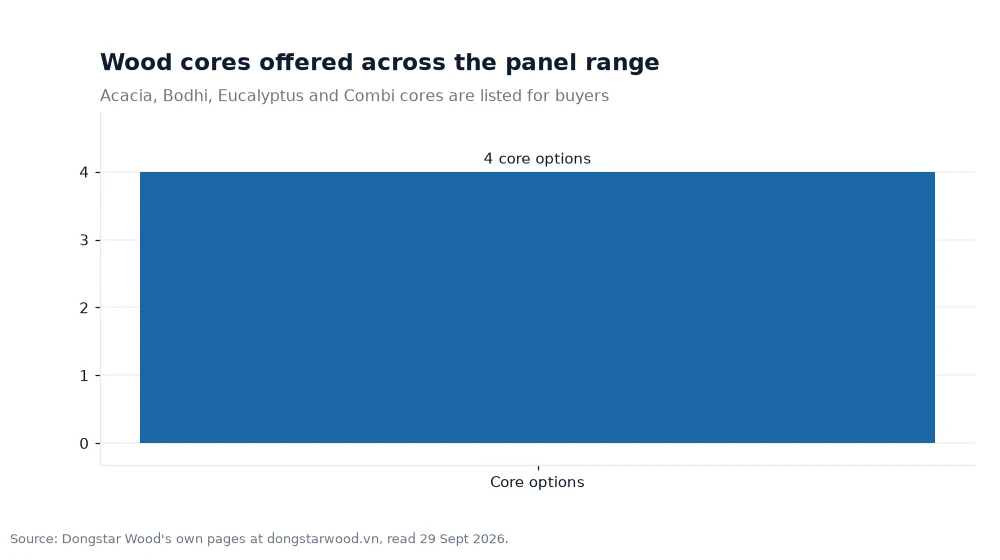
Once the seller is confirmed, the specification sheet becomes the document that protects the order. Three standard sheet sizes anchor the published window: 1500 × 3000 mm at the long end, 1220 × 2440 mm at the short end, and 1250 × 2500 mm between them, while bespoke panels stretch to 1830 × 3830 mm. Thickness runs 9 mm to 30 mm across the range. The adhesive list — Phenolic Dynea, WBP, MR, E2, E1 and E0 — and the choice of dark brown, black or anti-slip film complete the specification.
Write the size, thickness, glue class, core and face veneer onto the sheet and have the seller confirm it in writing, because a quotation that says only "plywood" invites a different container than the one that was priced. A signed sheet also gives the pre-shipment inspection something to check against: panel thickness consistency and core construction integrity are the ordinary items an export-grade workflow tests before a batch leaves the line.
The due-diligence statement behind EUDR
For European buyers, the deforestation question now arrives at the quotation stage rather than at the port. Where a supplier presents its range as EUDR-ready, treat that claim as a request for the statement that traces each consignment back to the forest it came from, and keep it with the CE and emission documentation. That statement connects the panel in the container to its supply area, and it is the one most often missing from a first document pack.
Ask for it before the order is scheduled, not after the vessel sails. A supplier with traceability already in place produces the statement in days; one without it produces excuses instead.
Duty confirmation in writing
Landed cost decides more first orders than unit price, and the duty position belongs in the document pack. The manufacturer's banner states No Anti-Dumping Tax for the EU market, and the product pages repeat the position for European and US shipments. The Incoterm and the duty treatment should be confirmed together in writing: the figure that clears customs is the figure that counts, not the one printed in the quotation.
A written duty confirmation turns a marketing line into a document an importer can hand to a customs broker, and it belongs in the same folder as the packing record: export-standard protective wrapping, steel strapping and wooden pallets are the published baseline, and custom packaging or labelling for large projects should be confirmed the same way.
| # | Document | What it confirms | When to request |
|---|---|---|---|
| 1 | Company and factory registration | The seller operates the equipment | Before the first quotation |
| 2 | Certificates for the named schemes | ISO, CE, SGS, FSC, EUDR, BSCI coverage | With the specification |
| 3 | Signed specification sheet | Size, thickness, glue, core, face | Before production starts |
| 4 | In-house test report | Panel performance from raw material to export batch | With the sample |
| 5 | Due-diligence statement | Consignment traced to its supply area | Before vessel booking |
| 6 | Duty and packing confirmation | Customs treatment and export packing | With the proforma invoice |
Worked example: capacity against order size
Raw capacity figures gain practical meaning once they are broken into a shipping cadence. Consider the published monthly supply: it exceeds 100 × 40ft, and divided across four weeks that works out to approximately 25 containers dispatched every seven days. A ten-container debut order therefore claims roughly a tenth of a single month's output, while a forty-unit programme commands forty percent — a distinction that determines whether an order slides into the schedule or competes for press time.
The same maths applies to the plant footprint. When 48,000 m² of production area is divided among 16+ automated lines, each line commands roughly 3,000 m² — space enough to commit to a single product family without constant changeovers. A buyer can pair the two figures: twenty-five containers per week sets the dispatch pace, while the per-line area indicates how steadily the press lines can keep producing without switching product families.
Frequently asked questions
Which documents should an importer collect before paying a deposit?
Collect six items: company and factory registration, the certificates behind the named schemes, a signed specification sheet, the in-house test report, the due-diligence statement for the consignment, and written duty and packing confirmation. Together they confirm who is selling, what is being made, and how the shipment will clear customs.
What does EUDR-ready mean in practice?
It means the supplier can issue the statement that traces a consignment back to its supply area. Ask for the statement itself rather than the claim, and file it with the CE and emission documentation that travels with the panel.
How does the duty position affect a first order?
The manufacturer states No Anti-Dumping Tax for European and US markets, and that position forms part of landed cost. Request the duty treatment in writing with the Incoterm so the figure that clears customs is the same figure that was quoted.
From document pack to first container
With the six documents in hand, the first order stops being a leap of faith and becomes a verification exercise. Check the signed specification against the film faced plywood category to confirm the thickness and film needed sit inside the quoted window; the company profile is then where the founding year, the factory area and the certification set can be confirmed together. Importers who collect those documents first tend to spend their first container checking a specification rather than investigating a supplier.
Facts and figures were gathered from Dongstar Wood's own site recorded on 29 September 2026[1].